How to Prepare Your Child to Become an AI and Robotics Engineer
Wondering how to set your kids up for the future? Here is the step-by-step coding and engineering roadmap parents need to know.
May 5, 2026
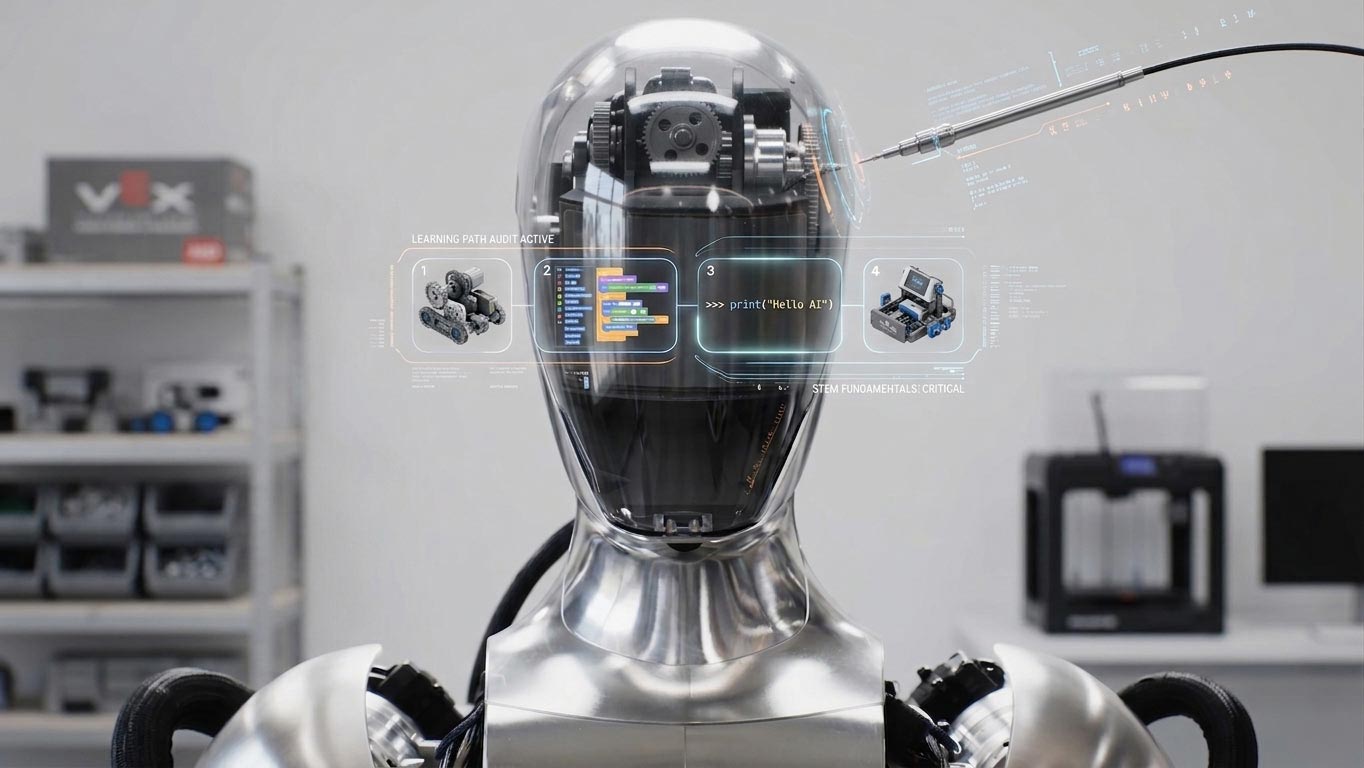
As parents, it is impossible to ignore the headlines: AI is advancing at breakneck speed, reshaping industries, and transforming the job market. At the same time, tech giants are racing to bring science fiction to life. We are watching the dawn of humanoid robots, from Tesla’s Optimus and OpenAI-backed Figure 01, to incredible innovations from Chinese robotics leaders like UBTECH’s Walker series and Unitree’s G1.
It’s natural to wonder what this means for our children's futures. Will there be jobs left for them?
The answer is a resounding yes — but the nature of those jobs is changing. The future belongs not to those who compete with AI, but to those who create, command, and innovate alongside it. Rather than worrying about our kids being replaced by this trend, our goal should be to position them to benefit from it. We want them to be the AI engineers, the robotics developers, and the tech leaders of tomorrow.
So, how do we get them ready? What skill sets do they need to start building now to turn passive screen time into future-ready STEM skills?
The Essential STEM Skill Set for Future Innovators
To build the next Optimus or program the next breakthrough AI model, kids need a blend of hardware and software skills, combined with a mindset geared toward computational thinking and problem-solving.
- Algorithmic and Logical Thinking: The ability to break down complex problems into manageable, sequential steps.
- Spatial Reasoning and Mechanics: Understanding how physical parts interact in a three-dimensional space.
- Computational Fluency: Mastery of coding languages to communicate effectively with machines.
- Resilience and Iterative Design: Learning that failure is just data, and debugging is a core part of building digital solutions.
A Proven Learning Path to Engineering Mastery
Becoming a robotics or AI engineer doesn't happen overnight. It requires a structured, engaging progression that grows with a child's cognitive abilities. Here is a practical, step-by-step learning path built directly into our extracurricular STEM curriculum to take kids from curious beginners to confident creators.
Step 1: Building the Foundation (Robotics & Engineering Mechanics)
Before kids can program a robot to "think," they need to understand how it moves. We start with hands-on, tangible building systems like VEX GO. At this stage, the focus is purely on mechanical engineering and spatial reasoning. Kids learn about gears, motors, and structural integrity. They build physical models with their hands, gaining an intuitive grasp of how hardware operates — a vital prerequisite for understanding advanced robotics.
Step 2: Grasping the Logic (Block-Based Coding)
Once the physical robot is built, it needs instructions. For younger learners, jumping straight into text-based coding can be frustrating. Instead, we introduce block-based coding environments, including foundational logic building through Scratch coding. By snapping together visual blocks of code, kids learn the core mechanics of programming — loops, conditionals (if/then statements), and sequencing — without getting bogged down by syntax errors. It bridges the gap between mechanical engineering and computer science, allowing them to see immediate, physical results from their logical commands.
Step 3: Powering Up (Complex Robotics & Python)
As their logical thinking solidifies, we step up the complexity. Kids transition to more sophisticated platforms like VEX IQ, which involve advanced sensors, complex drivetrains, and precise autonomous movements. Parallel to this hardware upgrade, they transition from block-based coding to Python — one of the most powerful and widely used languages in professional AI and machine learning fields today. Writing actual Python scripts to control complex robotic behaviors gives them a direct taste of what real-world software engineers do.
Step 4: Putting Skills to the Test (Competitive Robotics)
This is a pivotal moment in an engineering education. We strongly encourage kids to take their knowledge out of the classroom and onto the playing field by joining a SteamPi competitive robotics team. Participating in global competitions like the VEX IQ Robotics Competition moves them beyond structured lessons and into real-world engineering dynamics.
Students work collaboratively to analyze the season's specific game challenge, design and build a custom robot from the ground up, and program complex autonomous routines. Competitions teach resilience, strategic thinking, gracious professionalism, and rapid iterative design — essential skills for any future engineer. This is the stage where passive learning transforms into active, passionate innovation.
Step 5: Advanced Engineering & Future Applications
With a strong foundation in mechanical design, logical frameworks, and professional syntax, students are ready to tackle higher-level challenges. This stage involves open-ended problem solving, competitive robotics teams, and understanding how data drives decisions. They move from following instructions to designing comprehensive digital and physical solutions from scratch, mirroring the work of senior technical leaders.
Your Child's Journey Starts at SteamPi
At SteamPi, we’ve designed our entire curriculum around this exact progression. We know that the leap from a curious kid to a confident innovator requires the right environment, the right tools, and expert guidance. As a premier Vancouver coding academy, our facility provides a hands-on, engaging space where your child can master everything from foundational mechanics to advanced real-world applications through true project-based learning.
The AI revolution isn't something to fear; it is the ultimate toolkit for the next generation. Whether you are looking for top-tier Vancouver robotics classes, comprehensive STEM after-school programs in Vancouver, or engaging kids tech camps Vancouver, equip your child with the fundamentals they need to lead in the AI era.
Book a trial class today to see how SteamPi turns curious kids into confident, capable creators.
- AI Engineering
- Robotics Engineering
- STEM Education
- AI Era
- Generative AI
- ChatGPT
- Claude
- Gemini
- Cursor
- Codex
- Computational Thinking
- Algorithmic Thinking
- Block-Based Coding
- Scratch Coding
- Python For Kids
- VEX GO
- VEX IQ
- Robotics Competitions
- VEX IQ Robotics Competition
- Project-Based Learning
- STEM After-School Programs
- Robotics Classes
- Kids Tech Camps
- Vancouver Coding Academy
- Youth Robotics
- Future-Ready Skills
- Engineering Mechanics
- Spatial Reasoning
- Autonomous Robotics
- STEM Curriculum
- STEM Learning Path
- AI And Robotics Careers
- Coding For Kids
- STEM Enrichment
- Competitive Robotics Teams
- Engineering Design Process
- Problem-Solving Skills
- Logical Thinking
- STEM Pathway
- STEM For Kids
- STEM Education Vancouver
- Robotics Roadmap
- AI Career Path
- Engineering For Kids
- STEM Learning Journey
- Python Programming
- Competitive STEM