Coding Through Design Challenges
Why we teach programming with playful design briefs and creative constraints.
Dec 15, 2025
As parents, we are deeply invested in finding meaningful, productive activities that prepare our children (ages 6-14) for a rapidly evolving, competitive tech landscape. We want them to develop the critical thinking skills of computer science, but we also want them to be genuinely excited about the learning process.
We believe that the key to deep engagement is purpose. We strive to move beyond passive skill acquisition.
At SteamPi, we believe that the most powerful way to learn complex logic and engineering is by doing it physically.
We take the abstract logic that students learn in digital coding and apply it directly to a tangible, real-world scenario. A great story, like a scavenger hunt, is the perfect context for a physical simulation of a problem.
Here is how we bridge the gap between digital logic and physical engineering using VEX Robotics.
VEX Robotics and the Power of Physical Simulation
A design challenge is only powerful if it connects theory to practice. At SteamPi, we use the VEX competition field to simulate these complex problems. Instead of coding a character in a Scratch game, we ask our students to write the code that commands a physical VEX robot to interact with a physical environment.
Here is why this methodology is so effective for engineering-focused education:
Constraints Give Beginners a Clear Starting Point
A blank screen or a pile of VEX Robotics parts can be overwhelming. We provide specific constraints (like, "Your robot must navigate a specific section of the VEX competition field representing Stanley Park while maintaining full control") or "Use only two motors to make your bot retrieve an item." These physical limitations provide immediate clarity, giving them a logical foundation to start creating without getting overwhelmed by options.
Open-Ended Goals Invite Multiple Correct Answers
Tutorials often grade on a binary: did you copy the instructions correctly? We focus on outcomes. If the challenge is to cross a simulated map, there may be ten different ways to engineer the physical robot and code it to achieve the goal. With our personalization and high-attention mentorship, we have the time to guide, challenge, and celebrate all ten distinct physical solutions.
Physical Simulation and Storytelling Keep Students Engaged Longer
The most significant feedback loop in STEM education happens when a student sees their thinking become tangible. When a student codes their VEX robot to execute a mission, they are visually invested. They get immediate, physical feedback: a sensor detects an object, a mechanical arm moves, or the robot solves a maze. This visual storytelling ensures they remain engaged longer and build a deep, intuitive understanding of computer science and physics fundamentals.
A Sample Challenge: The Vancouver Scavenger Hunt Simulation
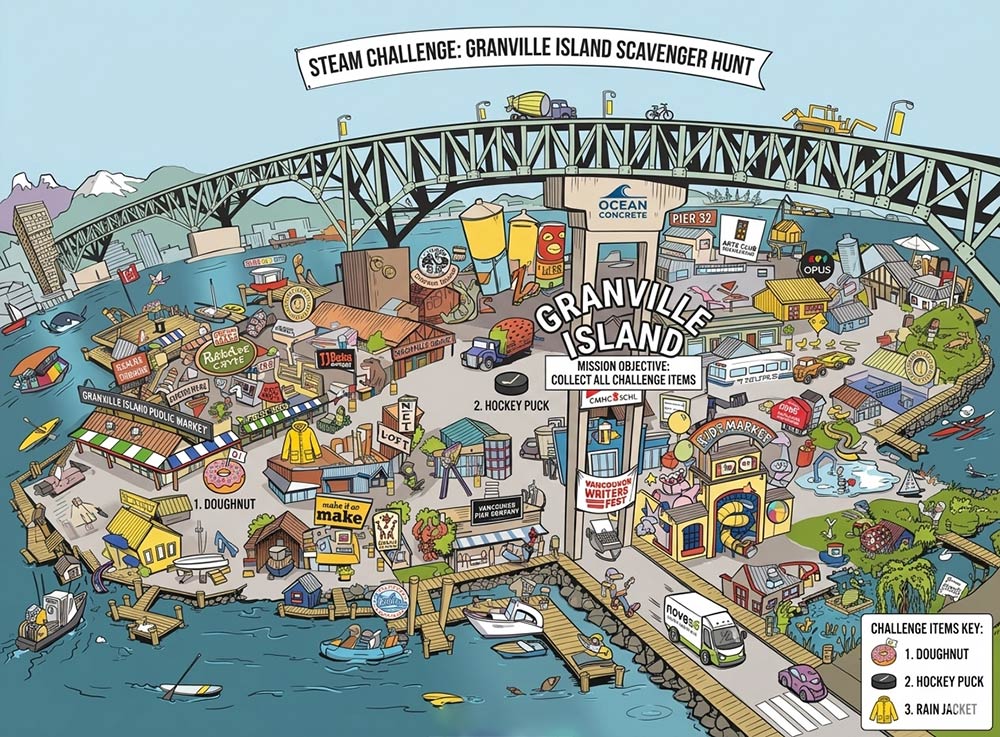
To understand how this looks in practice, here is a VEX simulation challenge we frequently use for our intermediate students in Vancouver.
The Creative Problem: We provide a physical game map of Vancouver placed on the VEX competition field. On this map, students are given a specific starting point and three unique physical objects representing local landmarks (for example, a Granville Island doughnut, a hockey puck, and a ferry ticket).
The Task: Students must engineer their physical VEX robot to navigate the simulated map, retrieve all three items, and then return to the starting base, potentially celebrating with a small choreographed action.
The Engineering Concepts (Hidden in the Fun):
- Sequencing (of robot movements): Developing the logic needed to retrieve items in a specific, efficient order.
- Sensor Integration: Programming the robot to detect the physical boundaries of the simulated map and object presence.
- Motor Control: Engineering the correct speed and torque needed for precise maneuvers and mechanical functions (picking things up).
- Variables: Creating logic to track how many physical items the robot has collected.
This challenge is not about perfect memorization of code, it is about organizing complex, multifaceted thoughts to solve an exciting mechanical puzzle.
Building Toward a Pathway: Our Competitive VEX Robotics Team
These simulated design challenges are the exact type of thinking and engineering needed for a competitive robotics environment. For students who show dedication and a genuine passion for engineering puzzles, we are actively recruiting for our competitive VEX Robotics team for the upcoming competition season. This gives kids a tangible, exciting roadmap that moves them from simulating a story to competing on a professional level.
What to Try at Home
You do not need a VEX field to start this at home. Pick a theme your child genuinely loves (space, animals, or sports like hockey) and challenge them to build a simple physical challenge. Example: "Challenge your child to build a creature (using LEGO or other building toys) that can carry three apples (blocks) across the kitchen floor." Even simple, non-digital constraints help complex creative ideas turn into a foundational engineering solution.
Ready to See Your Child Build a Story?
If you are looking for an environment where your child is seen as an active engineer and creative problem-solver, come visit us at our Vancouver academy. Stop guessing about their progress and experience personalized mentorship that bridges the gap between digital code and real-world results.
Come visit us to see the difference a design-focused robotics challenge can make. Book a trial class at our Vancouver academy today, or drop by to see our robotics lab and physical challenges in action. Let us engineer something amazing together.
- Coding Through Design
- Design Challenges
- Robotics Education
- VEX Robotics
- STEM Education
- Project-Based Learning
- Computational Thinking
- Physical Computing
- Engineering Design
- Creative Constraints
- STEM For Kids
- Vancouver STEM
- Robotics Competitions
- Hands-On Learning
- Scratch Coding
- Sensor Integration
- Motor Control
- Sequencing Skills
- Problem Solving
- STEM Pathway
- Kids Coding Classes
- Vancouver Coding Academy
- Active Learning
- Design Thinking
- Robotics Challenges
- STEM Creativity
- VEX Competition Field
- Coding With Constraints
- Engineering For Kids